Venezuelan Civil Society at the UN Demands the Renewal of the Mandate of the Fact-Finding Mission on Venezuela
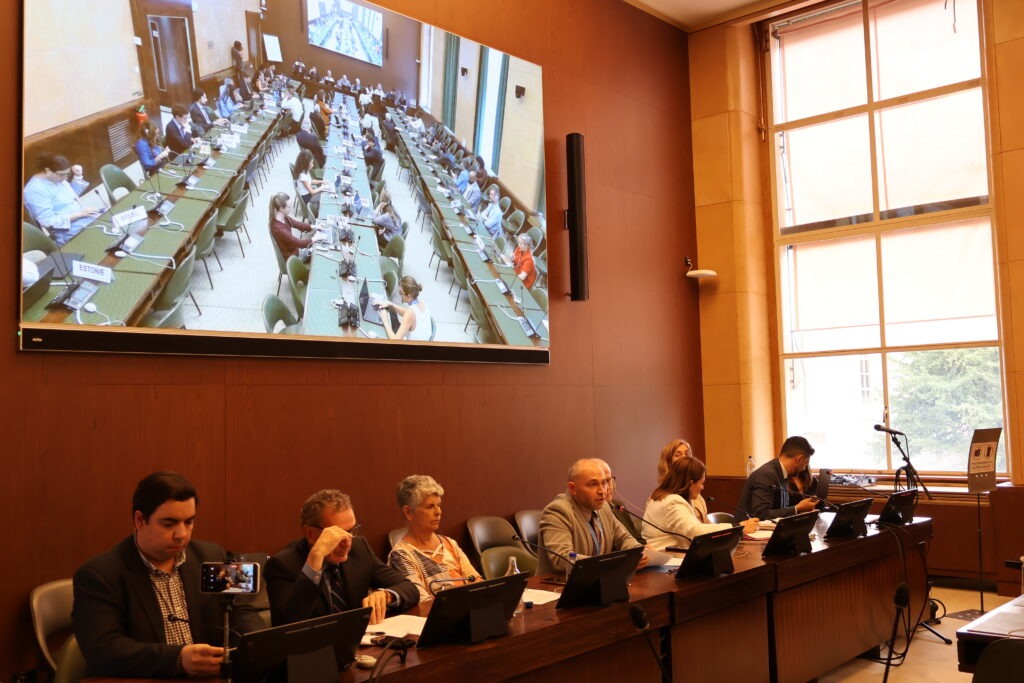
Within the framework of the 63rd session of the United Nations Human Rights Council, civil society organizations Aula Abierta, International Service for Human Rights (ISHR), Civilis Internacional, Alerta Venezuela, Friedrich Naumann Foundation, International Commission of Jurists (ICJ), Amnesty International, International Network for Human Rights Europe (RIDHE), Due Process of Law Foundation (DPLF), Center for Human Rights at the Andrés Bello Catholic University (CDH-UCAB), PROVEA, Global Centre for the Responsibility to Protect (GCR2P), International Federation for Human Rights (FIDH), Cepaz, Voto Joven, Acceso a la Justicia, and CIVICUS hosted the side event «The Urgent Need to Renew the Independent International Fact-Finding Mission on Venezuela.» The event took place on September 16, 2026, at the Palais des Nations in Geneva, Switzerland.
The meeting featured special participation from Alex Neve, Maria Eloisa Quintero, and Sofía Macher—experts from the Independent International Fact-Finding Mission on the Bolivaric Republic of Venezuela—as well as Dr. Gloria de Mees, Commissioner of the Inter-American Commission on Human Rights (IACHR) and Rapporteur for Venezuela.
A Space for International Gathering and Independent Protection Mandates
During the opening remarks, David Gómez Gamboa, director of Aula Abierta and professor at the University of Zulia, welcomed the diplomatic delegations, civil society representatives, and members of international bodies present, extending a warm greeting with special deference to the represented mandates.
Gómez Gamboa emphasized that the reasons behind the creation of the Mission persist in 2026 and that the mechanism retains fundamental strategic utility in the present and future context regarding the fight against impunity, the documentation and determination of responsibility for grave human rights violations, and the building of historical memory.
Sociopolitical Context of Venezuela in 2026
Ligia Bolívar, university professor at UCAB and director of the NGO Alerta Venezuela, stated that the current political situation in Venezuela does not correspond to a transition to democracy, but rather to a reshuffling of forces where political, economic, and repressive structures remain intact.
«In the analysis we published at Alerta Venezuela on January 3, we characterized the situation in Venezuela as a tutored transition. The passing months allow us to affirm that Venezuela is not undergoing a transition to democracy, but a reshuffling of forces. Those holding power were already part of the political, economic, and repressive structures that remain in place,» she said.
She explained that while releases from prison have taken place, these do not entail full freedom or the closure of judicial proceedings. Impunity persists for those responsible for arbitrary detentions and torture, citing the case of Emirlendris Benítez, who, after being documented by the Mission, suffered torture resulting in the loss of her pregnancy and mobility.
Bolívar reported that between January and July 2026, 161 violations of freedom of expression were recorded, according to data from Espacio Público, confirming patterns of censorship, internet blockages, and harassment against those expressing opinions on public affairs. Furthermore, she denounced institutional breakdown following the non-application of the Amnesty Law by Delcy Rodríguez to transfer requests to the so-called «Program for Democratic Coexistence and Peace,» an informal, discretionary entity that operated without a decree or legal basis, and whose initial 100-day term was extended indefinitely. She also indicated that despite requests to verify figures, Venezuelan authorities failed to provide lists or allow access to penitentiary centers, currently operating in the country through a confidential extension of their letter of understanding.
Regulatory Architecture and Restriction of Civic Space
Ricardo Villalobos Fontalvo, academic and director of Civilis Internacional, argued that a web of 38 regulations contrary to the Constitution and international treaties remains in place in Venezuela, designed to punish and persecute civil society organizations.
He highlighted the Law for the Oversight of NGOs approved in August 2024, which conditioned the legal status of organizations on costly procedures and requirements that force the disclosure of sensitive victim information. He noted that, according to a survey of 101 NGOs, 20.8% suspended operations and only 3.4% of human rights organizations successfully registered, in contrast to a 25% acceptance rate for strictly humanitarian organizations.
The academic further detailed that the Liberator Simón Bolívar Organic Law prescribes prison sentences of up to 30 years and disqualifications of up to 60 years for promoting international scrutiny. Additionally, he presented figures from the Civic Monitor, which documented 99 repressive events and 395 instances of rights violations between April and June affecting freedom of association, expression, and participation.
Regarding the state response to the recent earthquakes in northern Venezuela, he reported that authorities deployed barely 12.6% of their capacity in the first 24 hours, while entities such as SEBIN and the PNB actively obstructed independent collection centers and intimidated community shelters.
«In light of the above, at Civilis we emphasize that any reinstitutionalization agenda must prioritize the total repeal of this restrictive legal framework. Amending it or ‘relaxing’ its application is not enough: while this architecture exists, it is impossible to guarantee justice, truth, reparation, and non-repetition in a context where the State itself refuses to investigate. Likewise, full freedom for detained human rights defenders and prosecuted individuals must be prioritized,» the expert commented.
For his part, David Gómez Gamboa, director of Aula Abierta, intervened as moderator to raise the alarm regarding daily power outages exceeding 8 hours in the regions, as well as the policy of financial asphyxiation and monthly salaries of under two dollars targeting Venezuelan universities, aimed at their demobilization and the collapse of the educational system.
«The State has implemented a systematic policy characterized by indicators of ‘grand corruption,’ interventionist practices, and financial strangulation against universities and academics. This dismantles higher education and suppresses critical thinking, academic freedom, university autonomy, and the human rights of academic communities. A university professor’s salary is less than $2 a month. The goal is to remove universities from public debate, capture them, and collapse the education system amidst a severe weakening of civic space,» explained the academic.
International Crimes
Clara del Campo, Campaigner for Latin America at Amnesty International, stressed that the policy of repression remains active in its structures, personnel, and practices, focusing her presentation on the systematic use of arbitrary detentions, torture, enforced disappearances, and persecution. She highlighted the failure to fulfill obligations to provide official information on individuals in custody, noting that coordinated work by NGOs and family members currently accounts for between 328 and 400 individuals arbitrarily detained on political grounds.
The Amnesty International representative illustrated the continuation of these practices through recent cases, such as those of teenagers Samantha Hernández and her sister Aranza, the case of Oscar Morales, and the situation of Juan Carlos Marrufo at the Rodeo I judicial center, reminding that the denial of urgent and adequate medical care can constitute acts of torture.
«Detentions, ill-treatment, torture, and enforced disappearances continue. The lack of medical care is particularly revealing, illustrative, and alarming. We recall that the lack of urgent and adequate medical attention that results in severe physical or psychological suffering—done with the knowledge or intent of custodians—can constitute torture. This is all too frequent today,» she remarked.
She also warned of the recurring practice of unannounced transfers that amount to enforced disappearances, citing the case of Jorge Guanares, whose whereabouts have been unknown since August 2, 2024.
Furthermore, Del Campo condemned the continuation of open criminal cases and restrictive measures against human rights defenders such as Carlos Correa, Carlos Julio Rojas, Javier Tarazona, and Rocío San Miguel.
Continuity of the Repressive Apparatus and Structural Impunity
Santiago Canton, university professor and Secretary General of the International Commission of Jurists (ICJ), asserted that the repressive apparatus has not been dismantled because it was deliberately built to retain power.
«The Venezuelan repressive apparatus was built with a very specific purpose: retention of power. And the pattern repeats itself. Whenever a real possibility of change emerged—whether through street action or electoral means—the response was the same: stay in power at all costs and wait for the winds to shift again,» Canton stated.
According to presented data, while the government reported 8,000 beneficiaries under the Amnesty Law, the Office of the United Nations High Commissioner for Human Rights (OHCHR) was only able to confirm 1,149 releases between late 2025 and June 2026.
In addition, Canton affirmed that Venezuelan judges do not act independently and continue to apply anti-hate and anti-terrorism legislation under instructions from the National Executive. An example is the case of Víctor Quero, who was detained and forcibly disappeared in January 2025; his death in custody at the Rodeo I Judicial Center in July of that year was concealed by the State from his mother, Carmen Navas, until May 2026.
In light of all documented cases, he stressed that guaranteeing the effective enjoyment of human rights requires the effective conviction of those responsible for crimes against humanity, the restoration of the rule of law through a transparent reform of the Supreme Tribunal of Justice, and the prompt call for democratic elections.
Lack of Transparency in the Renewal of Judicial Authorities
Carlos Lusverti, director of the Center for Human Rights at the Andrés Bello Catholic University (CDH-UCAB), focused his analysis on the renewal process of judicial authorities and oversight bodies in Venezuela, warning that lack of timely information, opacity, and absence of accountability have been constant features of these procedures.
Lusverti denounced consecutive reforms to the Organic Law of the Supreme Tribunal of Justice aimed at increasing the number of magistrates and altering the composition of the Civil Society Nominations Committee, noting a lack of due transparency and public participation.
«To the point that 10 days after the law was passed, it has still not been published in the Official Gazette. The same occurred with the appointment processes for the new Prosecutor General and Ombudsperson. Neither possesses the necessary constitutional credentials for these roles. In the specific case of the Ombudsperson, a specific constitutional mandate requiring a recognized track record in human rights was not met,» he said.
Given this scenario, he concluded that it is imperative for the international community to maintain strict oversight over the appointment of the TSJ and proposed justice system reforms in the country.
International Scrutiny
For his part, Luis Carlos Díaz, representative of Transparencia Venezuela, in an analysis shared with Aula Abierta, asserted that victims in the country require sustained international scrutiny beyond economic and oil dynamics. He further denounced that the strategy of Venezuelan authorities has been to isolate the country from international mechanisms—as occurred with the OAS and is currently happening regarding the International Criminal Court (ICC)—obstructing investigations to shrink spaces for demanding justice.
Consequently, Díaz highlighted that the Venezuelan crisis directly involves the international community, as citizens of over 30 nationalities, including international humanitarian workers, have been victims of arbitrary detentions, enforced disappearances, torture, and incommunicado detention in the country.
In light of this, he put forward four concrete requests to Member States:
- Renew the mandate of the Fact-Finding Mission and the Office of the High Commissioner for Human Rights for Venezuela. Both mechanisms must cooperate and operate freely within the country.
- Provide necessary resources and time to continue investigating, assigning responsibilities, and preserving evidence. Significant information under their mandate remains to be uncovered.
- Maintain international scrutiny as long as Venezuela lacks independent institutions capable of investigating these crimes—especially the crime of persecution, which impacts migration dynamics of concern to the international community.
- Listen to and protect victims, both Venezuelan and foreign. Any transition process must include truth, justice, reparation, and guarantees of non-repetition. While that long-term goal is pursued, released detainees currently require urgent humanitarian assistance, as many are departing under dire conditions.
Finally, the convening organizations reiterated that the renewal of the Independent International Fact-Finding Mission is vital to prevent the consolidation of risk factors for atrocity crimes, objectively assess whether state measures constitute genuine changes or mere temporary maneuvers, and guarantee the complementarity of UN protection mechanisms in defense of civil society and academic communities in Venezuela.